
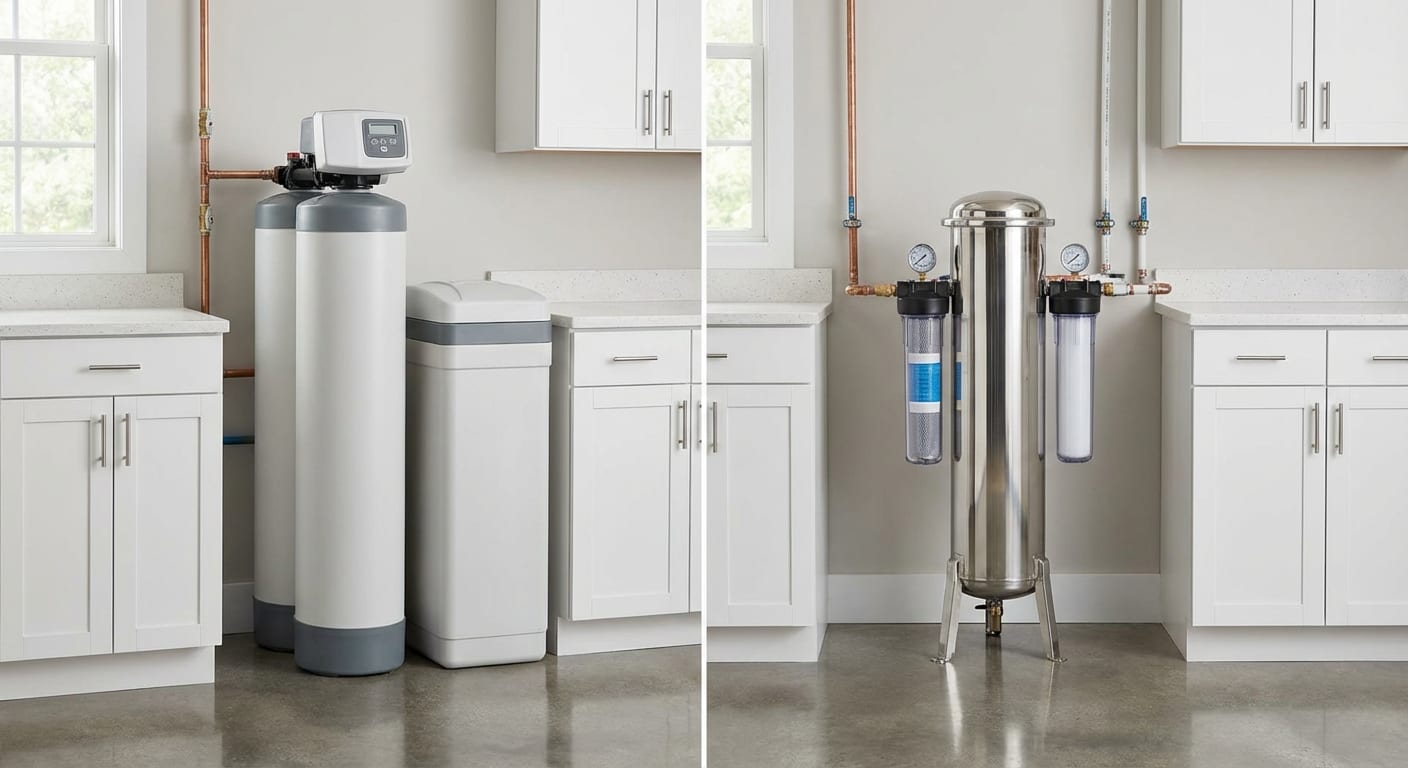
Understanding the Difference Between Softeners and Filters
One of the most common questions we get from Spokane homeowners is whether they need a water softener or a water filter. The short answer is that these are two fundamentally different systems that solve different problems, and many homes in our area actually need both. Understanding what each system does, and what it does not do, is essential to making the right investment for your home.
A water softener addresses water hardness. A water filter addresses water contaminants. These are separate issues, and no single system handles both perfectly on its own.
What a Water Softener Does
A water softener uses a process called ion exchange to remove hardness minerals, specifically calcium and magnesium, from your water supply. The system contains a tank filled with resin beads that carry a sodium (or potassium) charge. As hard water flows through the tank, the calcium and magnesium ions are attracted to the resin and swap places with the sodium ions. The result is water that is free of the minerals that cause scale buildup, soap scum, and appliance damage.
What a Softener Removes
- Calcium (primary hardness mineral)
- Magnesium (secondary hardness mineral)
- Some dissolved iron (up to 2-5 ppm depending on the system)
- Small amounts of manganese
What a Softener Does NOT Remove
- PFAS (forever chemicals)
- Chlorine and chloramines
- Nitrates
- Bacteria and viruses
- Lead and other heavy metals
- Sediment and particulates
- Volatile organic compounds (VOCs)
- Arsenic
What a Whole-House Water Filter Does
A whole-house water filter, also called a point-of-entry (POE) system, treats all the water entering your home by passing it through one or more filtration media. Depending on the type of filter, it can remove a wide range of contaminants including chlorine, sediment, PFAS, heavy metals, and organic chemicals. The most common filtration technologies for whole-house systems include activated carbon, catalytic carbon, KDF media, and sediment filters.
What a Filter Removes (Depends on Type)
- Chlorine and chloramines (activated carbon)
- PFAS (activated carbon and specialized media)
- Sediment, sand, silt, and rust (sediment filter)
- Volatile organic compounds (carbon)
- Some heavy metals (KDF or specialized media)
- Taste and odor issues
What a Filter Does NOT Do
- Remove calcium and magnesium (does not soften water)
- Prevent scale buildup in pipes and appliances
- Eliminate soap scum and hard water spots
- Improve soap lathering
Side-by-Side Comparison
| Feature | Water Softener | Whole-House Filter | Combined System |
|---|---|---|---|
| Removes hardness (scale) | Yes | No | Yes |
| Removes PFAS | No | Yes | Yes |
| Removes chlorine | No | Yes | Yes |
| Removes sediment | No | Yes | Yes |
| Removes heavy metals | No | Varies | Yes |
| Prevents scale buildup | Yes | No | Yes |
| Improves soap lathering | Yes | No | Yes |
| Reduces soap/detergent use | Yes (50-75%) | No | Yes |
| Protects appliances | Yes | No | Yes |
Why Spokane Homes Need Both
Here is the reality for Spokane-area homeowners: you are dealing with two separate water quality challenges at the same time. Your water is very hard at 13 grains per gallon, which demands a softener to protect your plumbing and appliances. And with documented PFAS contamination in the region, along with naturally occurring minerals and potential well water contaminants, you also need effective filtration.
Installing only a softener leaves your family exposed to PFAS, chlorine, and other contaminants. Installing only a filter means your pipes will continue to scale up, your water heater will lose efficiency, and your appliances will wear out prematurely. The most complete solution is a combined system that addresses both problems.
Combined Systems: The Best of Both Worlds
Modern water treatment systems can combine softening and filtration into a single, integrated unit. Puronics systems, for example, use SilverShield HYgene technology that combines ion exchange softening with advanced filtration media in one system. This approach provides comprehensive water treatment without the need for two separate units, two sets of plumbing connections, and two maintenance schedules.
Benefits of a Combined System
- Single unit saves space (important in Spokane basements and utility rooms)
- One maintenance schedule instead of two
- Addresses both hardness and contaminants comprehensively
- Often more cost-effective than purchasing two separate systems
- SilverShield technology inhibits bacterial growth in the tank
- Single point of installation on main water line
How to Decide What Your Home Needs
The best way to determine the right system for your home is to start with a professional water test. A comprehensive test will measure your water's hardness level, pH, iron content, TDS (total dissolved solids), and screen for contaminants like PFAS, nitrates, and bacteria. Based on the results, you can make an informed decision about whether you need softening, filtration, or both.
- Get a water test: This is the foundation of any water treatment decision. Do not guess what is in your water.
- Assess your hardness: Anything above 7 gpg warrants a softener. At Spokane's 13 gpg, a softener is strongly recommended.
- Check for contaminants: If PFAS, chlorine, sediment, or other contaminants are detected, filtration is needed.
- Consider your household: Larger families use more water and need appropriately sized systems.
- Think long-term: A combined system costs more upfront but saves money over time through lower maintenance and better protection.
Frequently Asked Questions
Can a water filter soften my water?
No. Standard water filters, including activated carbon filters, sediment filters, and even most reverse osmosis systems, do not remove the calcium and magnesium that cause water hardness. Some salt-free "water conditioners" claim to address hardness, but they do not actually remove the minerals. They attempt to change the mineral structure so it is less likely to form scale, but independent testing shows mixed results. True ion exchange softening is the only proven method for removing hardness minerals.
Will a water softener remove PFAS?
No. Water softeners use ion exchange resin designed to attract calcium and magnesium ions. This resin does not capture PFAS molecules. If PFAS is a concern in your water (and it should be for Spokane-area residents), you need either an activated carbon filter, a reverse osmosis system, or a combined system that includes filtration media designed for PFAS removal.
Is it worth the extra cost to get a combined system?
For Spokane homes, yes. Given that our water is very hard (13 gpg) and PFAS has been detected in the region, a combined system addresses both problems with a single installation. One installation is also simpler than installing a separate softener and a separate filter.
How long do these systems last?
A quality water softener typically lasts 10-20 years with proper maintenance. The resin may need replacement every 10-15 years. Whole-house filters vary by type: carbon filters need media replacement every 3-5 years, while sediment pre-filters need replacement every 3-12 months depending on your water quality. Combined systems have similar lifespans to standalone softeners, with periodic filter media replacement as needed.
Do I still need an under-sink RO system if I have a whole-house filter?
For drinking water, a point-of-use reverse osmosis system provides the highest level of purification. While a whole-house filter reduces many contaminants, an RO system at the kitchen sink removes 90-99% of virtually all contaminants, including PFAS, dissolved solids, sodium from softening, and trace pharmaceuticals. Many Spokane homeowners opt for a whole-house softener-filter combination plus a kitchen RO system for the most comprehensive protection.


